
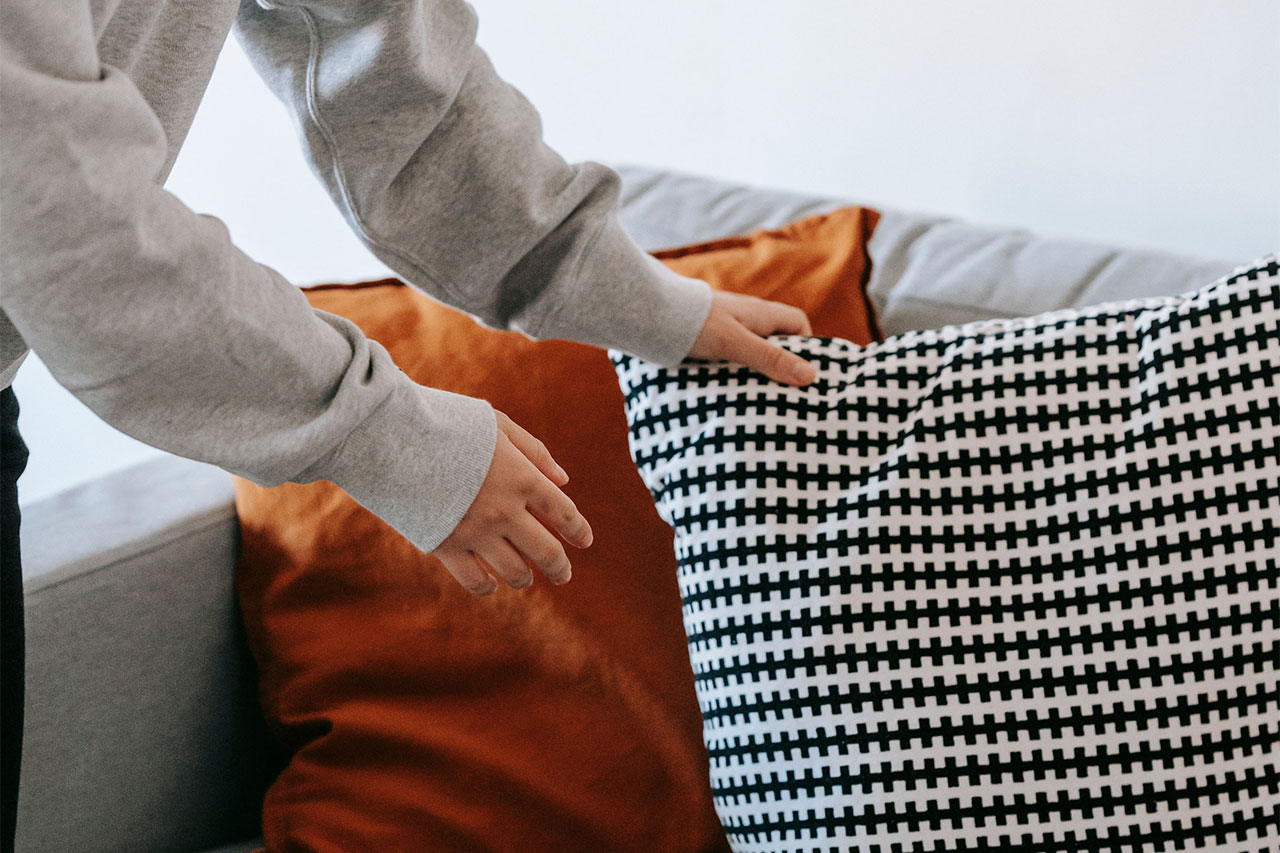
Pillows solve two futon problems at once: they replace the deep back cushioning a futon doesn’t have, and they break up the large flat plane that makes a futon read as a mattress rather than a sofa. Get the sizes and inserts right and a futon looks like furniture. Get them wrong and you’ve added clutter to the same flat plane.
Start with the structural problem, not the decorative one.
The back-support problem comes first
A sofa has a deep, soft back you can sink into. A futon in sofa position has a flat vertical plane. That’s the single biggest difference in how the two feel to sit on, and it’s why people describe futons as uncomfortable even when the mattress is fine.
Pillows are the fix, but only if they’re substantial enough to do structural work. Small decorative pillows do nothing for back support — they compress to nothing and slide out of position. You need at least two large, firm pillows against the back, and everything else is styling on top of that.
Bolsters are worth considering here. A long bolster running the width of the back, or two shorter ones at the ends, provides continuous support in a way that square pillows don’t, and it reads as deliberate rather than piled-on.
Sizes and counts
Large squares (roughly 22–24 inches) do the structural work at the back. Two of these is the base layer on a full-size futon.
Medium squares (around 18–20 inches) sit in front of the large ones and do most of the visual work.
Small squares and lumbars (around 12×20 or 14×20) go at the front as accents and provide lower-back support when seated.
Counts that work:
- Twin or chair: two or three total
- Full: three to five
- Queen or larger: five to seven
Odd numbers look more relaxed; even numbers look more formal and symmetrical. Neither is wrong — but pick one approach and commit, because a nearly-symmetrical arrangement reads as a mistake rather than a choice.
The more common error is too many rather than too few. Pillows that have to be moved before anyone can sit down will get moved once and then live on the floor.
Inserts matter more than covers
This is the part that separates a styled futon from a sad one, and it’s the part people skip.
Size up the insert. Use an insert one to two inches larger than the cover — a 20-inch insert in an 18-inch cover. This fills the corners and gives the pillow a plump, upholstered shape. A same-size insert leaves limp, empty corners, which is the single most recognizable sign of cheap styling.
Fill type. Feather and down inserts have a soft collapse and take a karate chop; they need fluffing and they flatten under weight. Down-alternative and polyester inserts hold their shape better and are the practical choice for a piece that’s sat on daily, particularly if anyone in the house has allergies.
Firmness for the back pillows. The large back pillows need firmness to do their job. Soft inserts compress to nothing under a leaning adult.
You can replace tired inserts without replacing covers, which is a cheap way to revive an arrangement that’s gone flat.
Coordinating with the cover
The cover is the largest surface in the arrangement, so it sets the constraints.
Solid cover, patterned pillows. The most flexible approach. A neutral or solid cover accepts almost any pillow scheme, and you can change the scheme seasonally without touching the cover. If you’re undecided about color generally, this is the safe structure: restraint on the large surface, personality on the small ones.
Patterned cover, solid pillows. Pull colors out of the cover’s pattern for the pillows rather than introducing new ones. One pillow can carry a smaller-scale secondary pattern; more than that competes.
Mixing patterns. Vary the scale. One large-scale pattern, one medium, one small or textural, unified by a shared color. Same-scale patterns fight; different scales read as a collection.
Texture as a pattern substitute. If pattern isn’t your thing, mixing textures — a smooth weave, a nubby one, a pile — gives visual interest with none of the coordination risk.
If you’re choosing pillows and a cover at the same time, evaluate them together physically rather than on screen. Ordering swatches applies to the pillow fabric as much as to the cover, and matching two fabrics from photographs is unreliable.
Matching pillows made from the same fabric as the cover is the most cohesive option and works especially well when the futon needs to disappear into a room rather than stand out.
Arrangement
Symmetrical: matched pairs, mirrored left and right, largest at the back. Formal, tidy, and the easiest to maintain because there’s an obvious correct position.
Layered asymmetrical: large pillows at both back corners, medium in front of them, one lumbar off-center. More relaxed, more designed-looking, harder to restore after use.
Grouped to one side: everything clustered at one end, leaving the other end open. Works well when the futon is used for lounging with a defined “head” end.
Practical note: whichever you choose, the arrangement has to survive daily use. If restoring it takes more than fifteen seconds, it won’t happen after the first week.
Beyond pillows
Pillows do a lot, but three other things change how a futon reads:
A throw draped over one arm or corner adds texture, softens the rectangle, and absorbs daily wear so the cover doesn’t. It’s also the fastest seasonal change available.
A well-fitted cover underneath all of this is doing more work than the pillows are. A loose, wrinkled cover undermines any styling on top of it — fit starts with measuring.
Surrounding furniture. A side table, a proper lamp, a rug that the futon’s front legs sit on. Furniture that’s clearly furnished — rather than a futon floating alone against a wall — changes the whole read of the room. This is the same argument that decides futon versus sofa bed for a lot of people.
Seasonal changes without buying furniture
Pillow covers are the cheapest way to change a room, and they store flat.
Keep one set of inserts and rotate covers: lighter colors and smoother textures in warm months, deeper colors and heavier textures in cold ones. Two sets of covers plus one set of good inserts costs a fraction of new furniture and takes ten minutes to swap.
The same logic applies at a larger scale to the futon cover itself. Owning two covers means a seasonal change, a spare while one is washed, and roughly double the life of each.
Browse throw pillows, futon covers, and accessories.
Frequently asked questions
How many throw pillows should a futon have? Two or three on a twin, three to five on a full, five to seven on a queen. More than that and they get moved to the floor.
What size pillows work best on a futon? A mix: 22–24 inch squares at the back for support, 18–20 inch in front, and a lumbar at the front for accent.
Should pillow inserts be bigger than the covers? Yes — one to two inches larger. It fills the corners and is the main reason some pillows look plump and others look limp.
Should the pillows match the futon cover? They don’t have to. Matching reads cohesive and lets the futon recede; contrasting reads more designed. A solid cover with patterned pillows is the most flexible starting point.
Do throw pillows make a futon more comfortable to sit on? Meaningfully, yes, because futons lack a sofa’s deep back cushioning. Use large firm pillows for that job rather than small decorative ones.
Can I get pillows in the same fabric as my cover? Often, where the fabric is offered in both. Check the throw pillow range against your cover fabric.