
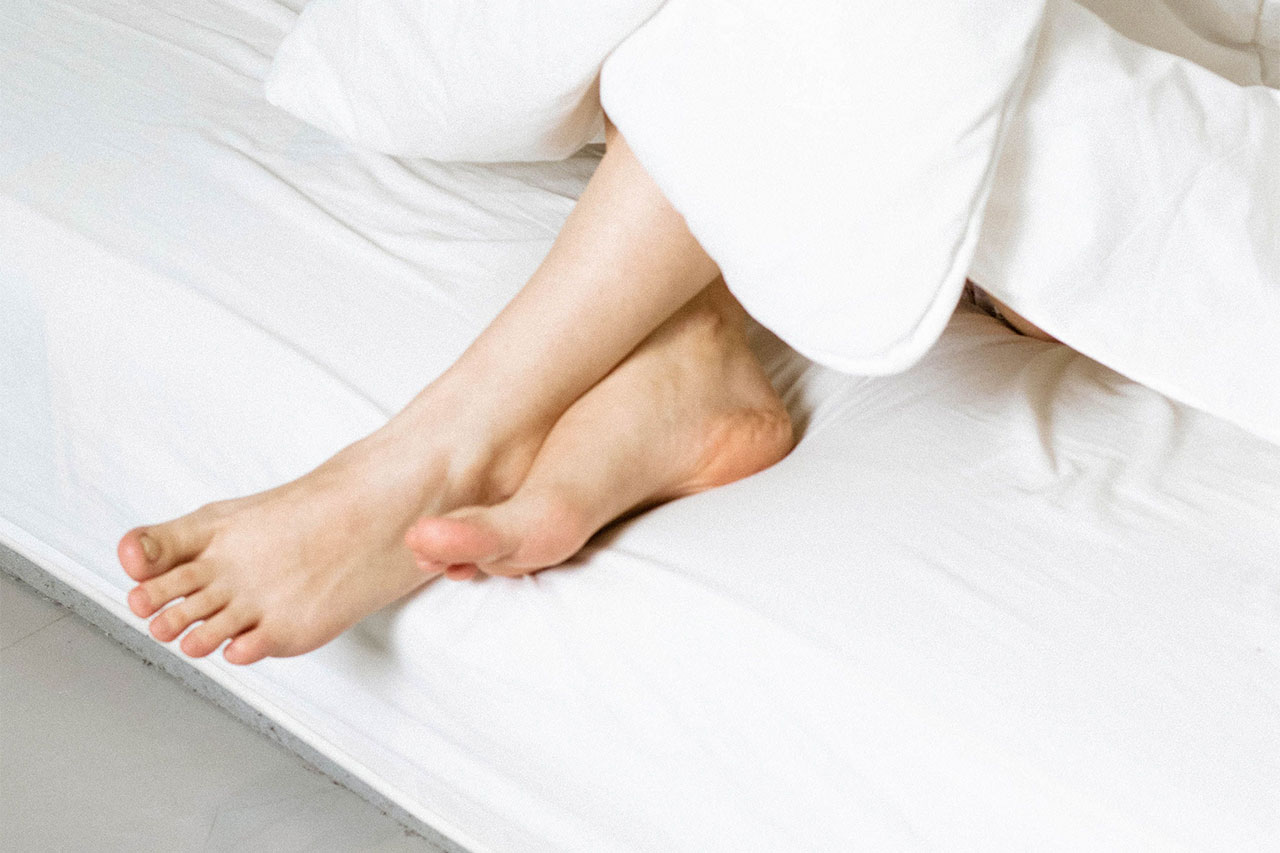
A futon mattress protector is a washable barrier that goes directly on the mattress, under the decorative cover. It exists because the mattress itself can’t be laundered — once liquid reaches cotton or foam fill, it stays there. The protector is the layer that takes the spill so the mattress doesn’t.
Whether you need one depends less on how careful you are and more on who uses the futon and for what.
The layer stack
Bottom to top:
- Mattress — not washable, expensive to replace
- Protector — washable, inexpensive, invisible
- Decorative cover — washable, visible, the thing you chose for looks
- Bedding, throws, seat pads — optional, easiest to launder
Each layer above the mattress is cheaper and easier to clean than the one below. The protector matters because it’s the last barrier before the layer you can’t clean at all.
Note that a decorative cover is not a protector. Standard cover fabric is woven and permeable — liquid passes straight through it into the fill. The cover protects the mattress from abrasion and light soil; it does not stop spills.
When a protector is genuinely worth it
Guest futons. You have no control over what guests do on it, and no visibility into what happened until much later. This is the strongest case.
Anyone sleeping on it regularly. Bodies produce moisture every night. Over years, that accumulates in fill that never gets washed.
Kids. Self-explanatory.
Pets. Accidents, but also hair, dander, and oils working down through the cover into the fill.
Anyone who eats or drinks on the futon. Which, in a studio apartment where the futon is the only seating, is everyone.
Allergy concerns. A tightly woven or encasement-style protector limits dust mite allergen movement between the fill and the sleeping surface.
Anything you plan to keep for years. The protector is a small fraction of the mattress cost and materially extends its usable life.
When you can skip it
A futon in a home office used as occasional seating, never slept on, never eaten on, in a household without pets or kids, is a reasonable place to skip the protector. Even then, a spare protector costs less than the regret.
Fitted versus encasement
Fitted protectors cover the top and sides with an elastic edge, like a fitted sheet. Easy to put on and take off, easy to wash frequently. They leave the bottom of the mattress exposed, which is fine for spills from above and useless against anything that reaches the underside.
Zippered encasements enclose the mattress completely on all six sides. Harder to install — you’re wrestling a whole mattress into a bag — but they’re the only option that seals the mattress fully. Choose an encasement if the concern is allergens, bed bugs, or a mattress that’s already had an incident and needs to be sealed.
For most households the fitted style is the right trade: good enough coverage, low enough friction that it actually gets washed.
Waterproof, water-resistant, or neither
Waterproof means a membrane backing. It stops liquid completely. The tradeoff is breathability — a membrane traps heat and moisture, which some sleepers notice as sleeping warm. Modern membranes are much better at this than older vinyl backings, but the physics don’t disappear entirely.
Water-resistant slows liquid rather than stopping it, buying you time to blot. More breathable, less absolute.
Neither — a plain quilted or woven pad — adds cushioning and absorbs light moisture but won’t stop a spill. Useful for comfort, not for protection.
Match the type to the actual risk. A child’s futon wants waterproof. An adult guest futon in a low-risk household is fine with water-resistant. Someone who sleeps hot and mainly wants a washable buffer might prefer neither.
The other tradeoff is noise. Membrane-backed protectors can crinkle when someone moves. Quality varies substantially — the cheaper the protector, the more likely you’ll hear it.
Sizing
Futon mattresses vary more than conventional mattresses do, and protector sizing follows the mattress, not the frame.
Measure width, length, and thickness on the bare mattress — the same three numbers you’d take for a cover. Thickness matters especially for fitted protectors: the elastic skirt has to reach far enough down the side to grip. A protector sized for a thin mattress will pop off a thick one every time someone shifts.
Conventional mattress protectors sometimes fit futons and sometimes don’t, because futon thicknesses often sit outside the range those products are cut for. Check the depth range on any product not specifically made for futons.
For odd sizes, protectors can be made to measure the same way covers are — cut-and-sew handles non-standard dimensions.
Care
Wash the protector on its own schedule, more often than the cover. Monthly is reasonable for a slept-on futon; after any incident, immediately.
For membrane-backed protectors, heat is the enemy: hot water or a hot dryer can damage or delaminate the membrane, at which point the protector is decorative. Wash warm or cold, tumble low or line dry. The general care principles for covers apply, with heat sensitivity raised a level.
Don’t iron a membrane-backed protector. Ever.
What a protector doesn’t do
It doesn’t stop the mattress sagging, lumping, or losing loft — those are compression and fill migration, and no surface layer prevents them. It doesn’t make a thin mattress comfortable. And it doesn’t replace rotating and flipping the mattress on a schedule.
If your futon’s problem is comfort rather than cleanliness, cover or mattress is the more relevant read.
The practical setup
For a guest futon that’s used a few times a year: fitted water-resistant protector, decorative cover over it, washed between guests.
For a daily-use futon in a studio: fitted waterproof protector, decorative cover, plus a washable throw over the seating area to take the daily wear. Wash the throw weekly, the protector monthly, the cover seasonally.
For a kid’s room: waterproof, fitted, and buy two so there’s always a clean one while the other is in the wash. This is the single most useful piece of advice on this page.
Browse accessories for protectors, and futon covers for the layer that goes over them.
Frequently asked questions
Does the protector go over or under the futon cover? Under. Protector directly on the mattress, decorative cover over it.
Isn’t the futon cover itself enough protection? No. Standard cover fabric is permeable — liquid passes through into the fill. The cover handles abrasion and light soil, not spills.
Do waterproof protectors make you sleep hot? Membrane backings reduce breathability to some degree. Better-quality membranes minimize it, but if sleeping hot is a known issue, water-resistant is the more comfortable compromise.
Can I use a regular mattress protector on a futon? Sometimes. Check the depth range — futon thicknesses often fall outside what conventional protectors are cut to fit.
How often should I wash a mattress protector? Roughly monthly on a slept-on futon, seasonally on occasional-use seating, and immediately after any spill.
Will an encasement stop bed bugs? A fully zippered encasement is used for that purpose because it seals all six sides. Effectiveness depends on the specific product’s construction and zipper design — check the product’s own claims.