
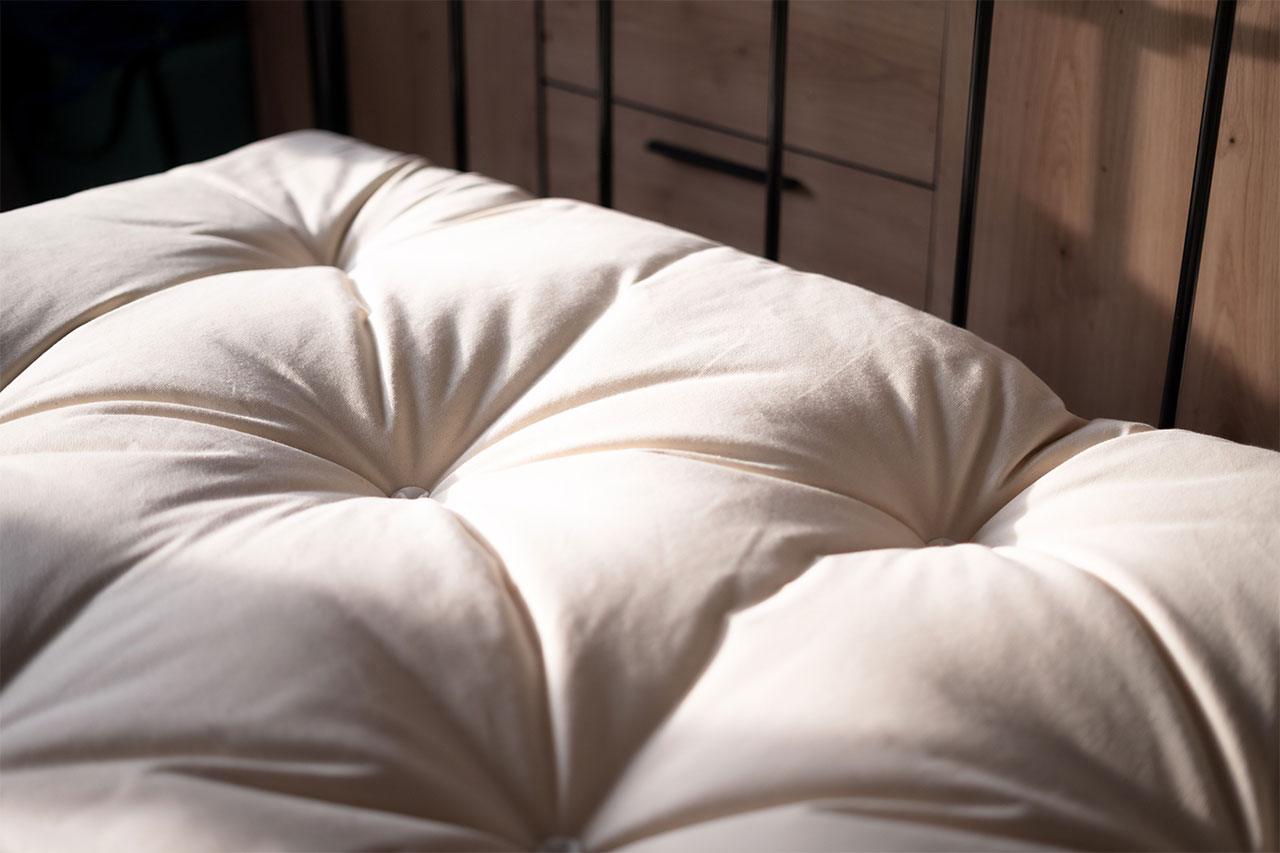
If the futon looks bad but still feels supportive, replace the cover. If it feels bad — sagging in the middle, lumpy, or bottoming out to the frame slats — replace the mattress. Comfort problems live in the mattress; appearance problems live in the cover. A new cover on a collapsed mattress buys you a better-looking uncomfortable futon.
That’s the short version. The diagnostic below sorts the ambiguous cases, which are most of them.
The five-minute test
Strip the cover off and put the bare mattress on the floor.
Look along it at eye level. A mattress that has a visible dip in the middle, or that’s noticeably thinner at the fold line than at the ends, has lost its fill. That’s structural.
Press down with a flat palm in several places. Compare the center against the ends. If the center compresses much further before resisting, the fill has migrated or broken down.
Lie on it for two minutes. On the floor, not the frame — the frame introduces its own variables. If you feel a ridge along the fold, or if your hips sink noticeably further than your shoulders, the mattress is the problem.
Now look at the cover. Held up to a window: are there thin patches where light comes through that shouldn’t? Are seams pulling apart? Is the zipper failing? Is there permanent staining or fading?
The bare mattress and the cover almost always give you different answers, which is the point of separating them.
Symptoms that mean the mattress
Sagging or a permanent dip. Fill has compressed and won’t rebound. Rotating and flipping buys some time; it doesn’t reverse it.
Lumps and hard spots. Cotton fill migrates over the years and clumps. Once it’s clumped, it stays clumped.
A hard ridge at the fold. On bifold futons, the fold line takes the most abuse. A permanent ridge there means the fill has broken down at the crease.
Feeling the slats. If you can feel the frame’s deck through the mattress, there isn’t enough functional fill left.
Waking up sore. If people consistently sleep badly on it and sleep fine elsewhere, that’s a support problem, not a fabric problem.
Noticeable thinning. Measure the thickness now and compare it to what it was when new. Substantial loss means substantial fill loss.
Odor that survives airing. Something has penetrated the fill. Surface cleaning won’t reach it.
Symptoms that mean the cover
Fading. Especially uneven fading where sun hits it. Purely cosmetic, entirely fixable with a new cover.
Stains that won’t come out. The mattress underneath is often perfectly fine.
Pilling or thin patches on high-contact areas — the seat deck, the front edge, the arms if the frame has them.
A failed zipper. Sometimes repairable, often not worth the labor relative to a new cover.
Seams pulling or splitting. Usually a sign of an undersized or overstretched cover, or simply age.
It looks dated, or it doesn’t work with the room anymore. Perfectly legitimate. A new cover is the cheapest possible way to change a room’s focal piece, and it doesn’t require a truck.
The cover shrank. After a hot wash. The mattress is unchanged.
The cases people misdiagnose
“It’s lumpy” when the cover is too loose. A cover with too much slack bunches and folds under body weight, and those folds read as lumps. Take the cover off and check the bare mattress before concluding the fill has failed. This is also the most common reason a cover is blamed for being uncomfortable.
“It sags” when the frame is the problem. Check the frame deck. A cracked slat, a bent support, or a sagging spring assembly produces exactly what feels like a mattress dip. Look at the frame before spending money on either the mattress or the cover.
“It slides around” — neither. A mattress that shifts on the deck is a friction problem, not a wear problem. Here’s how to stop it.
“It’s uncomfortable” on a mattress that was never right. Some futon mattresses are too thin or too firm for a given sleeper from day one. Age isn’t the cause; the original choice was.
When it’s both
A ten-year-old futon in daily use usually needs both, and there’s a reasonable order of operations.
If the mattress is going, replace it first, then measure the new one and buy a cover to fit it — measurements first. New mattresses are frequently a different thickness than the ones they replace, and a cover bought for the old dimensions may not fit the new mattress.
Doing it the other way around — new cover, then new mattress six months later — often means buying the cover twice.
The economics
A cover costs a fraction of a mattress and a small fraction of a new futon set. That asymmetry is why “just replace the cover” is right so often — but it also traps people into replacing covers repeatedly on a mattress that should have been retired.
A useful test: if you’ve bought two covers in three years and you’re still not happy sitting on it, the problem was never the cover.
Conversely, if the mattress is genuinely sound and the only complaint is appearance, a new cover is the highest-return furniture purchase available. Same footprint, same comfort, entirely different room.
Making the next one last longer
Whatever you replace, the failure modes are predictable and mostly preventable.
Rotate and flip the mattress on a schedule — quarterly is a reasonable default. This is the single most effective thing for fill life, and almost nobody does it.
Open the futon flat regularly if it lives folded as a sofa. Constant folding concentrates all the wear at the crease.
Use a protector under the cover. It intercepts spills before they reach fill that can’t be cleaned. What a futon mattress protector does covers the specifics.
Wash the cover cold and skip the dryer’s heat. Most covers that “wore out” were actually cooked.
Own two covers. Alternating them roughly doubles the life of each and gives you a spare while one is in the wash.
When you’re ready: browse futon covers, check accessories for protectors and grip strips, or see what’s on sale.
Frequently asked questions
How long does a futon mattress last? It depends on construction and use — daily-sleep use wears a mattress far faster than occasional guest use, and cotton-fill compresses more over time than foam. Judge by the bare-mattress test above rather than by the calendar.
Can a lumpy futon mattress be fixed? Rotating, flipping, and airing it in sunlight can redistribute fill somewhat and help temporarily. Once cotton fill has genuinely clumped, it doesn’t recover.
Will a new cover make an old futon more comfortable? Slightly, if the old cover was loose and bunching. Not at all if the fill underneath has broken down.
Should I buy the mattress or the cover first? Mattress first, then measure it and buy a cover to fit. New mattresses often differ in thickness from the ones they replace.
Can I add a topper instead of replacing the mattress? A topper can mask minor firmness complaints. It won’t fix a sag, a fold ridge, or a mattress you can feel the slats through — those are structural.